



Last updated: November 16, 2026

Quick answer: seasonal moisture and freeze-thaw changes can make a bowing basement wall look more pronounced within days or weeks, but the movement is usually driven by soil and water pressure around the foundation rather than the wall changing on its own. If the wall is already curved or pushed inward, the season can change how fast it moves and how obvious the movement looks. Because this is a YMYL issue with money and safety on the line, speak with a qualified foundation professional about your own situation before you assume the pattern is harmless.
Key takeaways
- Winter can make a wall look more stressed when frozen soil expands or when temperature swings expose weak spots.
- Spring often shows the biggest change because snowmelt, rainfall runoff, and wet soil raise pressure against basement walls.
- Seasonal movement is not random if the same wall changes after each wet period or freeze-thaw cycle.
- Tracking the wall at set times is more useful than guessing from one bad-looking day.
- Drain tile, grading, and soil moisture matter because they control how much water stays near the foundation.
Who should read this?
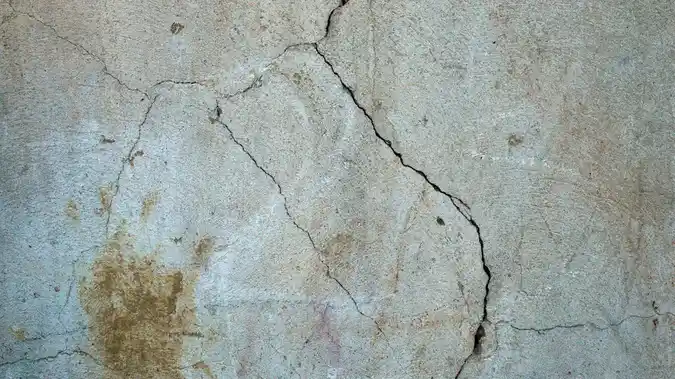
This applies to a homeowner who already sees a bowed wall, diagonal cracks, or a wall that looks different from one season to the next. It assumes you can look at the wall, note the month, and compare what happens after rain, snowmelt, or a hard freeze. It does not assume you can diagnose the structure yourself, so a qualified foundation professional is the safest source for a real assessment.
If the wall is moving fast, showing fresh cracking, or taking on water after a storm, the seasonal pattern is not the main question anymore. A qualified foundation professional should evaluate the wall, because timing can help explain movement but it does not prove the wall is safe. For background on visible signs, this page supports the main guide on how to tell if a basement wall is bowing.
Seasonal foundation movement is the key idea here. That means the same wall can look tighter, looser, or more bowed as soil moisture changes through the year. The point is to separate a wet-season pressure spike from a wall that is steadily failing over 12 months.
Why does winter make a basement wall seem worse?
Winter can make a basement wall seem worse because frozen ground, temperature swings, and thaw cycles change how the soil pushes on the foundation. The freeze-thaw cycle matters most in colder climates, where soil water can expand when it freezes and then settle again when it thaws.
That does not mean every winter creates new structural damage. In some homes, winter simply makes existing movement easier to notice because cracks open a little more or a bowed section becomes more visible against a straight edge. In other homes, snow cover reduces visible runoff, so the wall looks calmer until thaw arrives.
A common mistake is assuming that winter is always the worst season. Cold weather can expose the problem, but the pressure behind the wall may still be building from earlier wet soil. If the wall appears to change right after a freeze, note the date, the temperature swing, and whether the ground was already saturated before the cold spell. A 24-hour thaw after a freeze can matter more than the freeze alone.
Why does spring often look worse?
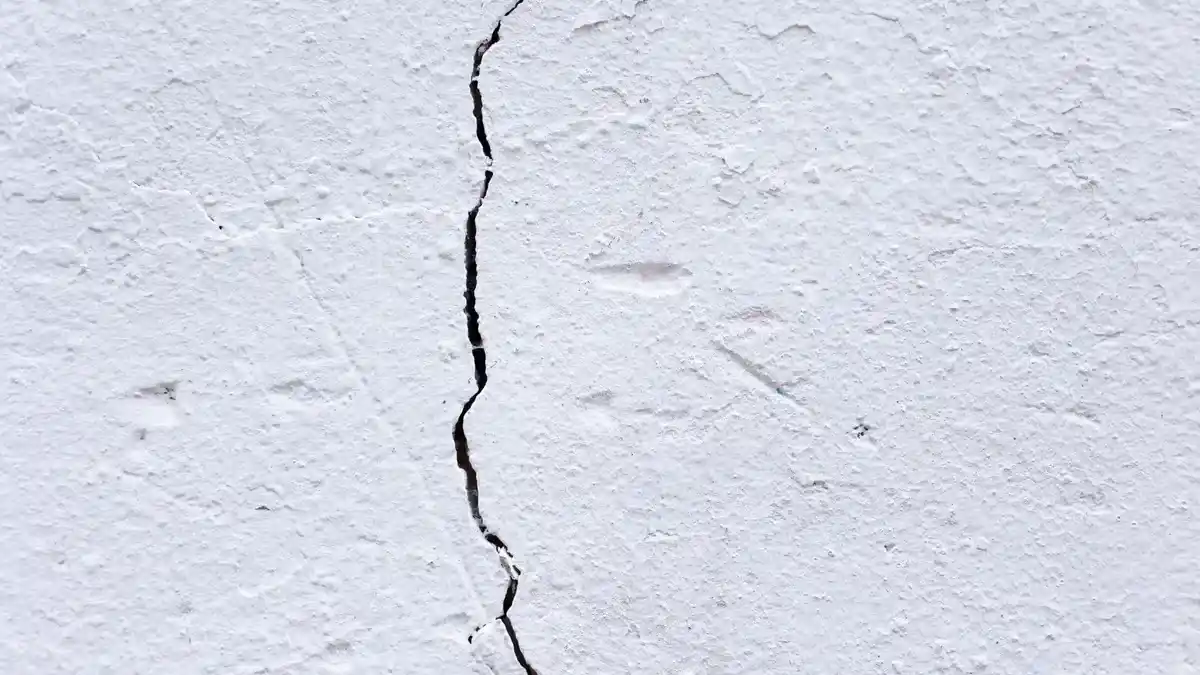
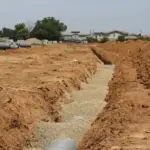
Spring often looks worse because snowmelt and rainfall runoff raise soil moisture and push more water against basement walls. Wet soil is heavier than dry soil, so the lateral pressure on the wall can climb after a wet week, a thaw, or a storm that sends water toward the foundation.
This is also when poor grading shows up. If the ground slopes toward the house, meltwater and rain can pool near the foundation instead of moving away from it. Drain tile can help control water at the footing level, but this page is about timing, not drainage fixes.
Spring movement is often the pattern that catches homeowners off guard. The wall may look stable in a dry January, then bow a little more in March or April after repeated wetting. That pattern does not prove a single cause, but it does point to water pressure as part of the problem. The U.S. Environmental Protection Agency explains how runoff moves across ground surfaces, and that runoff is part of why spring can be hard on basements.
For another authoritative overview of water around foundations, see the FEMA flood mitigation guidance.
How do seasonal changes affect bowing basement walls?
Seasonal changes affect bowing basement walls by changing the pressure outside the wall, especially from soil moisture, frozen ground, and runoff. The wall itself does not “feel” the season; it reacts to what the soil and water are doing around it.
Use this as a simple year-round tracking method if you want to connect movement to weather patterns:
- Pick one wall and inspect it at the same spot each time, such as a crack near the middle of the wall or a bowed section between studs. Verify that you are looking at the same area every time. If you keep switching spots, the pattern is meaningless.
- Record the month, recent weather, and whether the ground was wet, frozen, or thawing. Write down the last 7 days of heavy rain, snowmelt, or deep frost. If you cannot connect the wall change to a weather shift, the seasonal link may be weak.
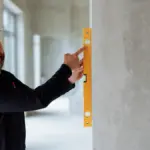
- Use a straight visual reference, such as the edge of a shelf, pipe, or joist line, to judge whether the bow looks more pronounced than before. Verify the same reference line is in view. If the reference itself is crooked, the comparison fails.
- Measure the same crack or offset in the same place each time, even if the change is small. A change after 1 month matters more than a dramatic guess from memory. If you cannot repeat the comparison, the record is not reliable.
- Check whether the change follows wet periods, not just cold ones. Look for a pattern after rain, snowmelt, or thaw, since soil moisture often drives pressure. If the wall changes only after dry cold weather, another factor may be involved.
- Note whether the wall changes are strongest near the bottom, where soil pressure is usually highest. Verify whether the bow appears more severe at floor level than higher up. If the whole wall seems to shift evenly, that is a different pattern.
- Compare 2 or 3 seasons, not just one storm. Seasonal foundation movement is about repeat timing across months. If the wall only looks worse once and then settles, you may be seeing a temporary moisture effect rather than a repeating trend.
The goal is not to become your own engineer. The goal is to tell whether the wall changes with weather in a repeatable way, or whether you are seeing one isolated bad day. A year of notes is better than 3 dramatic photos taken in one week.
What should you watch over 12 months?
You should watch for repeat changes after the same kind of weather over 12 months. A wall that looks worse every spring or after each thaw is telling a different story from a wall that looks unchanged through a whole dry summer.
Look for three things in particular: the direction of the bow, the amount of cracking, and any signs that the wall has stopped returning to its earlier position. If the wall looks slightly more bowed after each wet season, that suggests ongoing soil pressure. If it looks the same each year, the movement may be slow, but it still deserves attention.
A simple comparison helps:
| What you notice | What it often suggests | What makes it more concerning |
|---|---|---|
| Wall looks worse after thaw or spring rain | Seasonal soil pressure | The change repeats for 2 or more seasons |
| Wall looks calmer in dry weather | Moisture-driven movement | Cracks stay open even when the soil dries |
| Wall changes after snowmelt and runoff | Water is reaching the foundation | Gutters, grading, or drain tile are not controlling water |
| Wall seems unchanged through the year | Movement may be slow or stable | A fresh crack appears anyway |
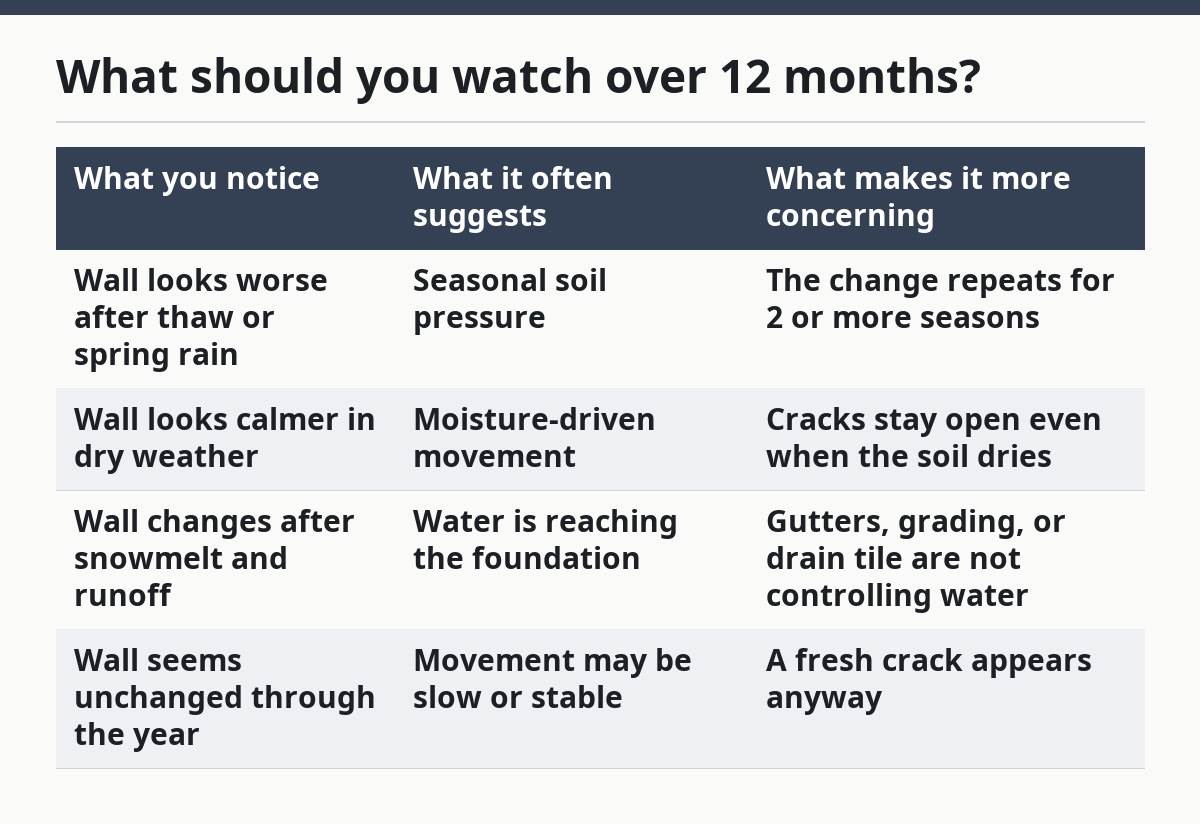
This kind of tracking helps a reader avoid two bad guesses: “it’s only seasonal, so ignore it,” and “it got worse once, so the wall is failing right now.” The truth is often between those extremes.
When should you stop relying on seasonal patterns?
You should stop relying on seasonal patterns when the wall is changing faster than the weather can explain. If a wall goes from “slightly bowed” to visibly more curved in a short period, the season is not the right lens anymore.
Fresh cracking after a wet period: This can mean the wall is still under active pressure, so stop treating it as a normal seasonal cycle and get a qualified opinion from a foundation professional.
Movement that continues in a dry stretch of 30 days or more: This suggests the wall is not just reacting to moisture — a professional should assess the cause.
Water entering the basement at the same time as the bowing changes: This raises the chance that drainage and pressure are working together — the wall needs review, not just observation.
One wall changes while the rest stay stable: Local soil or drainage conditions may be concentrating pressure in one spot — that is a structural clue, not a weather note.
Repeated spring worsening over 2 or more years: A repeating seasonal pattern can still be a real problem — waiting for the next cycle risks more movement.
A long crack or a wall that looks visibly out of plane from top to bottom: The pattern is no longer subtle — the wall should not be judged by season alone.
This is the place to be cautious. Seasonal movement can explain timing, but it does not clear the wall of risk. The more the wall changes outside the wettest or coldest part of the year, the less useful the seasonal explanation becomes.
What mistakes do people make with seasonal wall movement?
People usually make 4 mistakes, and each one costs time. The first is blaming winter alone and ignoring spring runoff, which misses the real pressure source. The better approach is to tie the change to the soil condition, not the calendar.
The second is comparing photos from different angles or distances. That makes a wall look better or worse than it is. Take each photo from the same spot, at roughly the same height, and with the same wall feature in frame.
The third is waiting for “proof” that the wall is getting worse before taking notes. By then, the key detail is gone. A 1-page log with dates, weather, and visible changes is more useful than memory.
The fourth is assuming drain tile or grading is the whole story. They matter because they affect soil moisture, but they do not explain every bowed wall. Some walls move because of structural loading, past damage, or long-term soil pressure that is not obvious from the yard alone.
The fifth is comparing a spring wall to a dry-season wall and calling the difference normal. Seasonal movement can be real, but repeated change is still movement. If the wall is a little worse every wet season, the pattern matters even if it is slow.
Is seasonal movement normal?
Seasonal movement can be common, but it is not something to dismiss as harmless. A wall that shifts with wet soil, runoff, and freeze-thaw cycles is showing how sensitive the foundation is to its environment.
That is why the right question is not “does winter or spring matter more?” The better question is “does the wall keep changing after the same seasonal trigger, and does it recover afterward?” If the answer is yes to repeated worsening, that is a warning sign, not a normal quirk.
For a homeowner, the practical value is in the pattern. If the wall looks stable through dry weather and only more pronounced after snowmelt or heavy rain, you have a clue about what is driving the pressure. If it changes during 2 or 3 separate seasons, the problem deserves a closer look than a guess from one cold month.
FAQ
Can winter make a wall bow more?
Yes, winter can make a wall bow look worse, especially when the ground freezes and thaws around it. The change may come from frost-related soil movement or from temperature swings that reveal existing weakness. A single cold snap does not prove structural failure, though repeated winter changes deserve attention.
Does spring rain worsen wall movement?
Yes, spring rain can worsen wall movement because it raises soil moisture and runoff around the foundation. Wet soil presses harder against basement walls than dry soil does. If the wall changes after snowmelt or several rainy days, that seasonal link is worth noting.
Is seasonal movement normal?
Seasonal movement can happen, but it should not be treated as automatically harmless. Some walls respond to wet soil, grading, and freeze-thaw cycles with small changes that repeat each year. If the movement keeps growing, repeats in the same spot, or continues during dry weather, the pattern is no longer something to shrug off.
How many seasons should you track before drawing a conclusion?
Track 2 or 3 seasons if the wall is stable enough to observe safely. That gives you enough data to see whether the same weather pattern keeps producing the same change.
What is the most useful thing to record?
The most useful thing to record is the timing of visible change next to rain, thaw, or snowmelt. A date, a photo from the same spot, and a note about wet or frozen soil are more useful than memory alone.
When should you call a professional?
Call a qualified foundation professional if the wall is changing quickly, fresh cracks appear after wet weather, or the wall keeps moving during a dry stretch.
Drafted with AI; not yet reviewed by a person.